Internet and Drop-Ship Activity Can Mask Core Practice Performance Trends
Why revenue and expense treatment matters for operating ratios, management interpretation, and decision quality
Author
Business Issue
Internet pharmacy, online diet, ancillary product, and drop-ship programs can add real profit. They can also make the practice look different from an operating perspective when gross third-party sales and related costs are blended into the practice income statement.
The issue is not whether internet or drop-ship activity is good or bad. The issue is whether leadership can clearly see the difference between core hospital performance, actual profit contribution, and a gross reported revenue-and-expense view.
When net-remittance activity is grossed up into revenue and COGS, operating ratios are distorted. Revenue can look higher, COGS can look higher, labor percentage can look lower, gross profit percentage can look lower, and EBITDA percentage can change even though the underlying hospital operation did not change in the same way.
Three Presentation Lenses Leaders Should Separate
View | What it Includes | Question it Answers |
|---|---|---|
Core practice view | Hospital operating revenue and related operating costs, with third-party internet activity separated. | How is the underlying practice operation performing? |
Management contribution view | Core practice results plus the actual internet or drop-ship profit, commission, or net remittance. | How much economic benefit did the activity add? |
Gross-reported view* | Gross customer deposits and related costs that actually flow through the practice or are withdrawn from practice receipts. | When actual gross cash flow exists, how do scale and operating ratios change when sales and costs are presented gross? |
* Gross-reported view: This lens is relevant for fact patterns such as drop-ship or third-party platforms where the practice actually receives gross revenue and has COGS, shipping, credit-card fees, sales tax, or similar costs withdrawn or paid. It is different from a net-remittance gross-up, where the practice receives only a profit check or commission but revenue and costs are later manufactured into the P&L.
What The BCV Example Shows
Best Coast Vet (BCV) received real profit checks from internet pharmacy and diet activity. The management question is not whether that profit matters. It does. There are two separate questions: should grossed-up revenue and expenses be included in the practice income statement, and should the profit contribution be allowed to blur the trend in the core practice? BCV is a net-remittance example. The practice received the profit checks; the third-party provider realized the gross customer revenue. That makes the grossed-up revenue and COGS a management reporting issue, not a normal gross-reported operating view of the practice.
BCV six-month view | Amount | What it means |
|---|---|---|
Grossed-up internet pharmacy and diet sales | $79,768 | Real customer revenue realized by the third-party provider, not the practice. |
Actual net profit/remittance in VizVet management view | $22,315 | The economic contribution included without treating the practice as if it received all gross customer payments. |
Incremental revenue created by grossing up | $57,453 | The difference between gross internet/diet sales and the net profit already included in the management view. |
Gross-up internet pharmacy and diet COGS | $57,542 | Costs created to offset grossed-up revenue to match the actual profit received. |
The grossed-up presentation increased reported revenue and COGS while leaving gross profit dollars nearly unchanged. That is why the distortion can hide in the ratios rather than the bottom-line dollar amount.
Reported revenue appears larger when gross internet sales are included.
COGS dollars and COGS percentage appear higher when related internet costs are added.
Labor percentage appears lower because the denominator is larger, even though labor dollars did not change.
Gross profit dollars remain nearly unchanged, but gross profit percentage declines.
Core practice revenue, margin, labor, EBITDA, and operating-ratio trends become harder to see unless the internet activity is identified separately.
Common Misunderstanding
A common misunderstanding is that if net income is approximately correct, the management information must also be correct. That is not always true. A gross-up of revenue and expenses can preserve the net dollar effect while changing the ratios managers use to run the practice. Leaders may still make staffing, pricing, inventory, compensation, budgeting, and EBITDA interpretation decisions from ratios that no longer reflect the same operating base.
Tax note: If gross revenue and related costs are both added, ordinary income-taxable profit may be largely unchanged. That does not solve the management reporting issue. In jurisdictions with gross- receipts-based taxes, fees, or rent clauses tied to gross receipts, gross-reported revenue may also create tax, filing, or lease considerations that should be reviewed with the practice's advisors.
The Reframing
The reframing is simple: the question is not whether internet and drop-ship activity adds profit. It can. The question is which view leadership is using when interpreting performance.
A technically reasonable net-income result can still produce weak management information if grossed-up revenue and costs alter the denominator behind COGS, labor, G&A, EBITDA, margin, and trend interpretation.
Decision Implication
Practices should evaluate internet and drop-ship revenue sources with and without gross-reported activity.
They should also decide, with their bookkeeper, CPA, or advisors, whether net-remittance activity should ever be grossed up into revenue and expenses when the practice never received the gross customer payments or paid the related gross costs.
For each source, leadership should understand:
whether the practice receives gross customer deposits or a net remittance
whether related expenses are actually paid by the practice
whether the practice controls the good or service before it transfers to the customer
how much actual profit or contribution the activity adds
whether the activity should be included, excluded, or shown separately when evaluating core operating performance
how inclusion or exclusion changes operating ratios
One goal is to avoid allowing grossed-up sales and costs into the management view when those dollars never hit the practice bank account. A second goal is to show the profit contribution without letting that contribution hide the core practice story.
Questions Leaders Should Ask
Before using internet or drop-ship activity to interpret performance, leaders should separate the accounting presentation from the economic contribution.
Did the practice actually receive the gross customer payment, or only a net remittance?
Were the related costs, fees, shipping, sales tax, or credit-card charges actually paid by the practice?
Did the practice control the goods or services before they were transferred to the customer?
Is leadership looking at a core practice view, management contribution view, or gross-reported view?
Would the trend look different if internet or drop-ship activity were shown separately?
Why Buyers and Advisors Care
In diligence, buyers and consolidators often ask whether online pharmacy revenue is booked net or gross. Net presentation means the practice records only the profit, fee, commission, or net remittance retained from the online store. Gross presentation means total online store sales are added to revenue, with related costs and fees also added to expenses.
That distinction matters because a gross-up can increase reported revenue and COGS without changing net profit. If the practice did not control the goods or services before transfer to the customer, the presentation may draw audit or diligence scrutiny and may require correction.
Diligence takeaway: A gross-up entry can overstate reported revenue and COGS relative to the practice's economic role, even when net profit is unchanged.
How VizVet Helps
This issue often surfaces when a practice's books do not match the VizVet dashboard view. That mismatch is not automatically a problem. It is a signal to ask which revenue view is being used.
VizVet's management view is designed to include the actual internet profit contribution without automatically treating third-party gross sales and costs as core practice revenue and expenses. Leaders can then compare views and see how internet activity affects operating results, operating ratios, and trend interpretation.
Practical result: The same practice can look stronger, weaker, larger, smaller, more efficient, or less efficient depending on whether gross internet activity is included in revenue, COGS, and ratio calculations.
Suggested Exhibit [[JD should this title now be changed? Also the paragraph below is obsolete. Should there be an explanatory paragraph or does the exhibit stand on its own?]]
For publication, use simplified VizVet exhibits rather than raw screenshots. The exhibits should show three views of the same practice so readers can see what changes when grossed-up amounts, profit contribution, or no internet contribution are included.
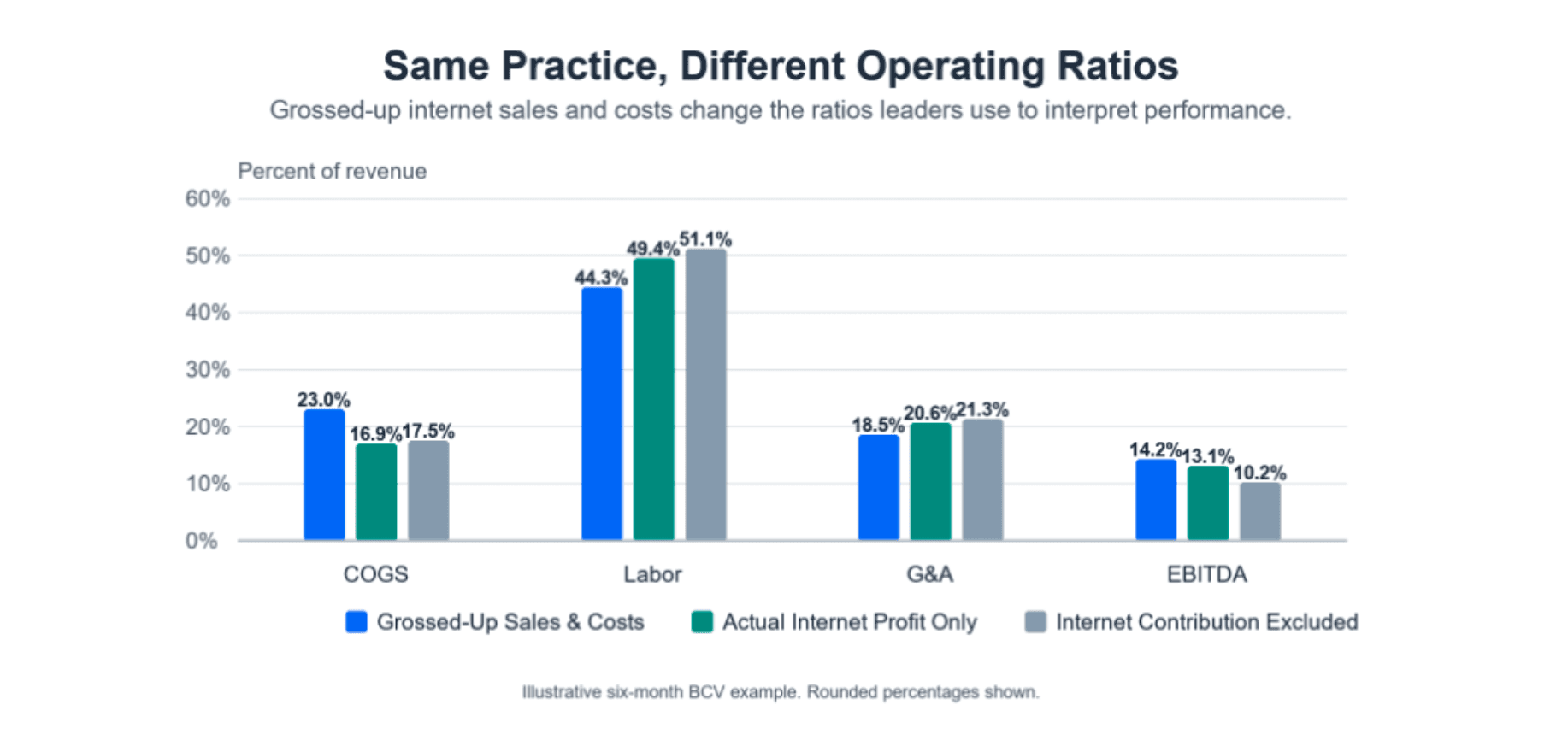
Figure: Grossed-up activity changes operating-ratio interpretation even when the underlying practice operation did not change.
Bottom Line
Internet and drop-ship programs can add real profit. But when grossed-up sales and costs are included without clear separation, they can mask core practice performance trends and distort the operating ratios leaders rely on. VizVet' job is to make that difference visible.
Related Resources / Future Resources
Technical brief: VizVet Technical Appendix - Internet and Drop-Ship Sales: Gross vs. Net Revenue Recognition (Working Draft 0.1), including FASB ASC 606 / ASU 2016-08 principal-versus-agent guidance.
Case study document: VizVet Case Study - Grossed-Up Internet and Drop-Ship Revenue Distorts Operating Ratios (Working Draft 0.1).
Case study PowerPoint: VizVet Internet and Drop-Ship Revenue Review Packet (Working Draft 0.1). Content cleanup should come before visual design refinement.
Future resources still needed: Best Practice workflow, definition-library entries, side-by-side dashboard use case, and internet/drop-ship activity classification checklist.